
内容概括
基于图神经网络的欺诈检测模型在数据聚合环节较为脆弱,可能被欺诈者有意攻击;主流鲁棒防御方法对数据不加区分地修改和截断,又会丢失原图中大量未受攻击部分的信息。论文提出生成式欺诈检测框架 GSRGNN:先用生成式结构得到增强的节点特征,再优先利用高度数节点构建局部更稳定的图结构,最后将增强后的特征和结构与原始输入成对送入图神经网络层,得到抗扰动的综合表示。论文还设计了黑盒攻击算法,模拟欺诈者对图特征和结构的扰动。实验使用电子交易平台数据与公开反欺诈数据集。
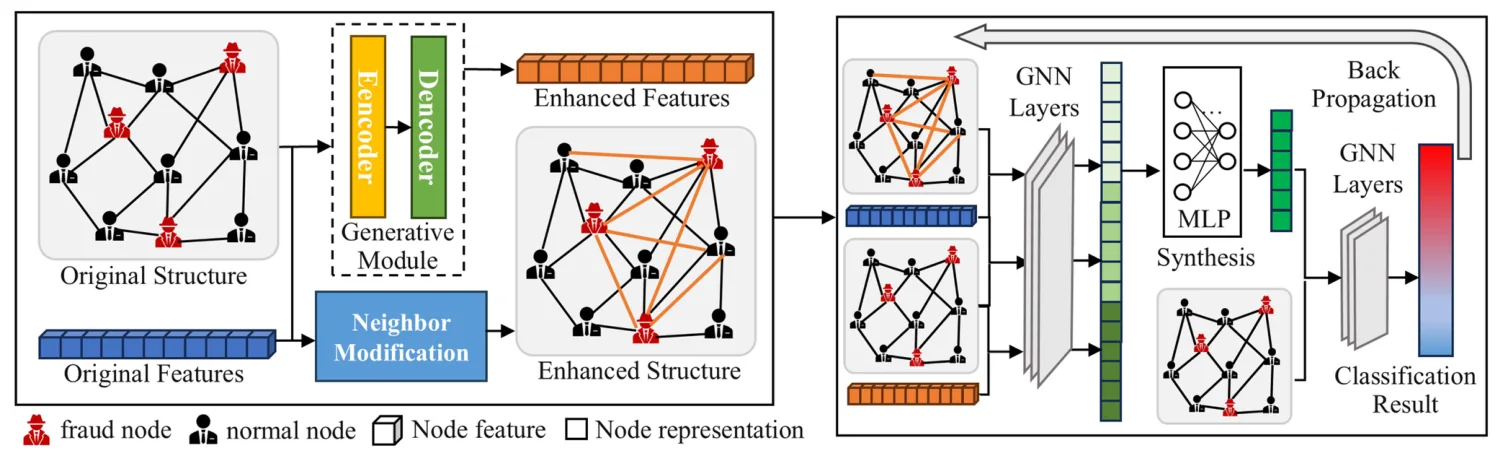
基于图神经网络的欺诈检测模型在数据聚合环节较为脆弱,可能被欺诈者有意攻击;主流鲁棒防御方法对数据不加区分地修改和截断,又会丢失原图中大量未受攻击部分的信息。论文提出生成式欺诈检测框架 GSRGNN:先用生成式结构得到增强的节点特征,再优先利用高度数节点构建局部更稳定的图结构,最后将增强后的特征和结构与原始输入成对送入图神经网络层,得到抗扰动的综合表示。论文还设计了黑盒攻击算法,模拟欺诈者对图特征和结构的扰动。实验使用电子交易平台数据与公开反欺诈数据集。
Fraud detection is a typical data mining mission in the field of finance. In recent years, due to their capability of mining hidden associations between entities, graph neural networks (GNNs) have been widely applied to detect financial fraudsters. However, GNNs are fragile in their data aggregation process and will be attacked on purpose by fraudsters, therefore, some other pioneers have explored methods to enhance the robustness of GNN-based fraud detection models. But most existing models based on ideal settings, as real-life criminals tend to attack as far as they can reach, struggle to establish a unified effective approach for attacked and unattacked data of different scales in realistic scenarios. Furthermore, mainstream robust defense models indiscriminately modifying and truncating data will lose important information of the major unattacked parts in the original graph, which lowers their overall fraud detection precision. Therefore, in this work, we propose a novel generative fraud detection framework called GSRGNN. In particular, we first design a generative structure to obtain augmented node features. Then we prioritize the nodes with high degrees to create a more stable graph structure on local distributions. Finally, we pass the enhanced features and structure with the input ones in pairs through GNN layers, and create synthetic representations with abundant information and sufficient resistance to perturbations for subsequent fraud detection. In addition, we also design a novel black-box attack algorithm to realistically imitate the perturbations conducted by fraudsters on graph features and structure. Experiments on the world's leading electronic trading platform and public anti-fraud datasets demonstrate the outstanding performance of our proposed method compared with those state-of-the-art models, showing its superiority in precision and robustness on financial fraud detection missions.
来源:TKDE 2026 · 原文摘要