
内容概括
论文提出并从理论上证明:类别同配性方差(CHV)高,是图神经网络在异常检测任务中表现欠佳的原因——常规节点分类数据集中各类的同配水平相近,而异常检测数据集中正常节点高度同配、异常节点则不然。为此,HEAug 以原有边为辅助,侧重生成 CHV 较低的新边:借助自注意力机制从头采样同配邻接矩阵,利用特征空间中相关但原图中未直接相连的节点,并修改损失函数以抑制不必要的异配边。实验覆盖异常检测、无边节点分类与对抗攻击等八个基准数据集,论文还定义了提高 CHV 的异配攻击,用于检验理论与模型。
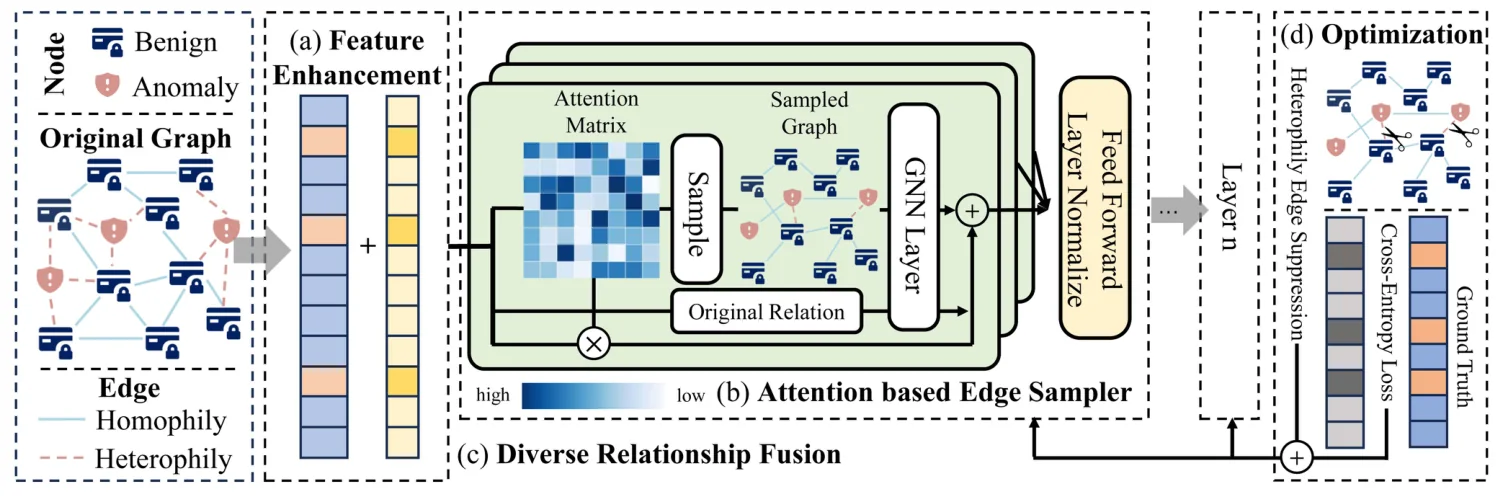
论文提出并从理论上证明:类别同配性方差(CHV)高,是图神经网络在异常检测任务中表现欠佳的原因——常规节点分类数据集中各类的同配水平相近,而异常检测数据集中正常节点高度同配、异常节点则不然。为此,HEAug 以原有边为辅助,侧重生成 CHV 较低的新边:借助自注意力机制从头采样同配邻接矩阵,利用特征空间中相关但原图中未直接相连的节点,并修改损失函数以抑制不必要的异配边。实验覆盖异常检测、无边节点分类与对抗攻击等八个基准数据集,论文还定义了提高 CHV 的异配攻击,用于检验理论与模型。
Graph Neural Networks (GNNs) have achieved remarkable success in machine learning tasks by learning the features of graph data. However, experiments show that vanilla GNNs fail to achieve good classification performance in the field of graph anomaly detection. To address this issue, we propose and theoretically prove that the high-Class Homophily Variance (CHV) characteristic is the reason behind the suboptimal performance of GNN models in anomaly detection tasks. Statistical analysis shows that in most standard node classification datasets, homophily levels are similar across all classes, so CHV is low. In contrast, graph anomaly detection datasets have high CHV, as benign nodes are highly homophilic while anomalies are not, leading to a clear separation. To mitigate its impact, we propose a novel GNN model named Homophily Edge Augment Graph Neural Network (HEAug). Different from previous work, our method emphasizes generating new edges with low CHV value, using the original edges as an auxiliary. HEAug samples homophily adjacency matrices from scratch using a self-attention mechanism, and leverages nodes that are relevant in the feature space but not directly connected in the original graph. Additionally, we modify the loss function to punish the generation of unnecessary heterophilic edges by the model. Extensive comparison experiments demonstrate that HEAug achieved the best performance across eight benchmark datasets, including anomaly detection, edgeless node classification and adversarial attack. We also defined a heterophily attack to increase the CHV value in other graphs, demonstrating the effectiveness of our theory and model in various scenarios.
来源:TPAMI 2026 · 原文摘要