
内容概括
违规关联交易形成复杂且动态变化的网络,现有时序图学习方法多把实体视为功能同质,忽略了节点多样且不断演化的结构角色。RPATGN 先分析节点的结构角色,采用依据交互双方角色调整聚合策略的角色消息传递机制;再结合由时序上下文注意力增强的变分图循环神经网络,显式建模角色动态与网络整体演化。论文在真实金融数据集上验证了方法在关联交易检测中的效果。
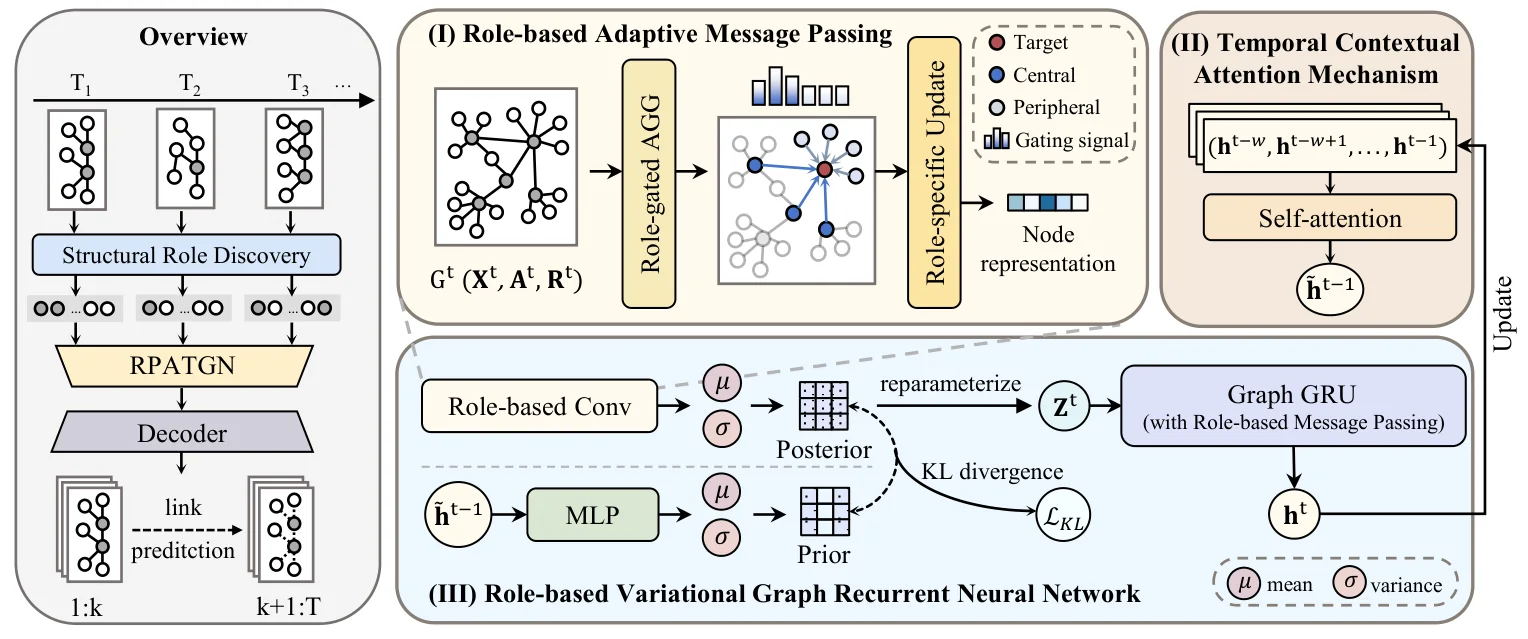
违规关联交易形成复杂且动态变化的网络,现有时序图学习方法多把实体视为功能同质,忽略了节点多样且不断演化的结构角色。RPATGN 先分析节点的结构角色,采用依据交互双方角色调整聚合策略的角色消息传递机制;再结合由时序上下文注意力增强的变分图循环神经网络,显式建模角色动态与网络整体演化。论文在真实金融数据集上验证了方法在关联交易检测中的效果。
Illegal related-party transactions (RPT) are federal felonies that pose a severe threat to the stability and integrity of modern financial systems. The increasing frequency of RPTs forms complex and dynamic networks. Existing temporal graph learning methods tend to treat entities as functionally homogeneous, ignoring the diverse and evolving structural roles of nodes. Role-based embedding methods model global structure by bridging same-role nodes, but their reliance on a unified mechanism for aggregation and evolution means they fail to distinguish the underlying logic of distinct interactions governed by structural roles. The limitations motivate us to develop a customized role-based strategy. It can also adapt to evolving RPT dynamics, thereby forming a continuous regulatory process to combat illegal activities. In this paper, we propose an innovative Role Perceptual Augmented Temporal Graph Network (RPATGN) for proactive RPT detection. We analyze the structural roles of nodes and employ a role-based message passing mechanism that adapts its aggregation strategy based on the roles of interacting nodes. We integrate a variational graph recurrent neural network, enhanced by temporal contextual attention, to explicitly model the dynamics of the roles and the overall network evolution. Extensive experiments on real-world financial datasets demonstrate the effectiveness of our approach for RPT detection. It holds practical significance for fostering robust financial systems and promoting healthy, transparent financial markets.
来源:AAAI 2026 · 原文摘要