
内容概括
信用欺诈风险常隐藏在异构的用户—风险图中,工业级图神经网络需要基于子图的分布式训练,而现有切分策略为兼顾负载均衡,会切断风险传播所依赖的长尾证据链。论文提出风险感知的重叠子图学习框架 RAOS:先构建负载均衡的基础分区,再在预算约束下采样信息量高的长尾节点,保留关键的风险扩散模式并过滤噪声;同时设计跨子图一致性对齐机制,对重叠节点施加对齐约束,使各子图的局部表示统一到全局一致的隐空间。实验基于微信支付的生产数据集。
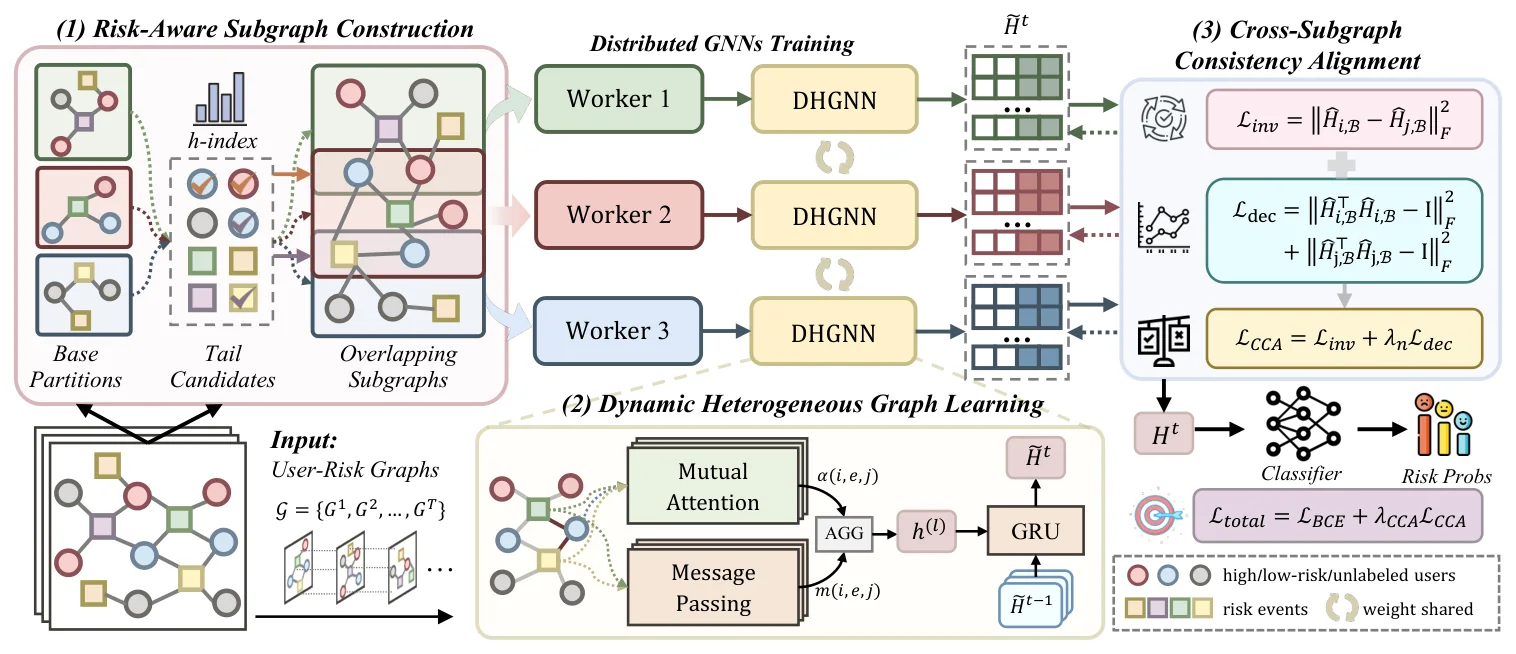
信用欺诈风险常隐藏在异构的用户—风险图中,工业级图神经网络需要基于子图的分布式训练,而现有切分策略为兼顾负载均衡,会切断风险传播所依赖的长尾证据链。论文提出风险感知的重叠子图学习框架 RAOS:先构建负载均衡的基础分区,再在预算约束下采样信息量高的长尾节点,保留关键的风险扩散模式并过滤噪声;同时设计跨子图一致性对齐机制,对重叠节点施加对齐约束,使各子图的局部表示统一到全局一致的隐空间。实验基于微信支付的生产数据集。
Credit risk detection, particularly mitigating individual fraud, is crucial for maintaining the stability of digital financial ecosystems. Accurately identifying credit fraud among billions of users is critical for minimizing financial losses and safeguarding the sustainability of inclusive financial services. Given that credit fraud risks are often concealed within heterogeneous user-risk graphs, Graph Neural Networks (GNNs) have emerged as an effective tool for risk mining by capturing complex dependencies. To address the scalability bottleneck of industrial GNNs, distributed training based on subgraphs is indispensable. However, existing strategies often compromise topological integrity for load balancing. This can be catastrophic for risk detection, as it indiscriminately severs the long-tail evidence chains essential for risk propagation. Overlapping subgraphs can restore severed risk contexts but inevitably introduce redundancy and noise, while overlooking the representation alignment across different local subgraphs. In this paper, we propose a risk-aware overlapping subgraph learning framework for large-scale credit risk detection. We first construct base partitions to ensure load balance. Then, we perform budget-constrained sampling that selects informative long-tail nodes, thereby preserving critical risk diffusion patterns while filtering out noise. To mitigate representation inconsistency, we design a cross-subgraph consistency alignment mechanism. By enforcing alignment constraints on the overlapping nodes, we harmonize the local representations into a globally consistent latent space. Extensive experiments on Weixin Pay’s production dataset demonstrate that our model significantly outperforms existing strategies for risk detection, offering a scalable and effective solution for industrial graph learning.
来源:KDD 2026 · 原文摘要