
内容概括
幌骗(spoofing)交易常出现分布漂移,历史数据的有效性随之下降,而模体等交易子结构在不同分布下相对稳定。SAG²M 用枚举算法统计邻居节点间的子图模式频率,将这些模体频率编码进结构增强的生成式框架,再通过时序异构图的生成与聚合收集邻域信息,用于识别合谋幌骗行为。论文在基准数据集上进行了实验,并给出案例分析。
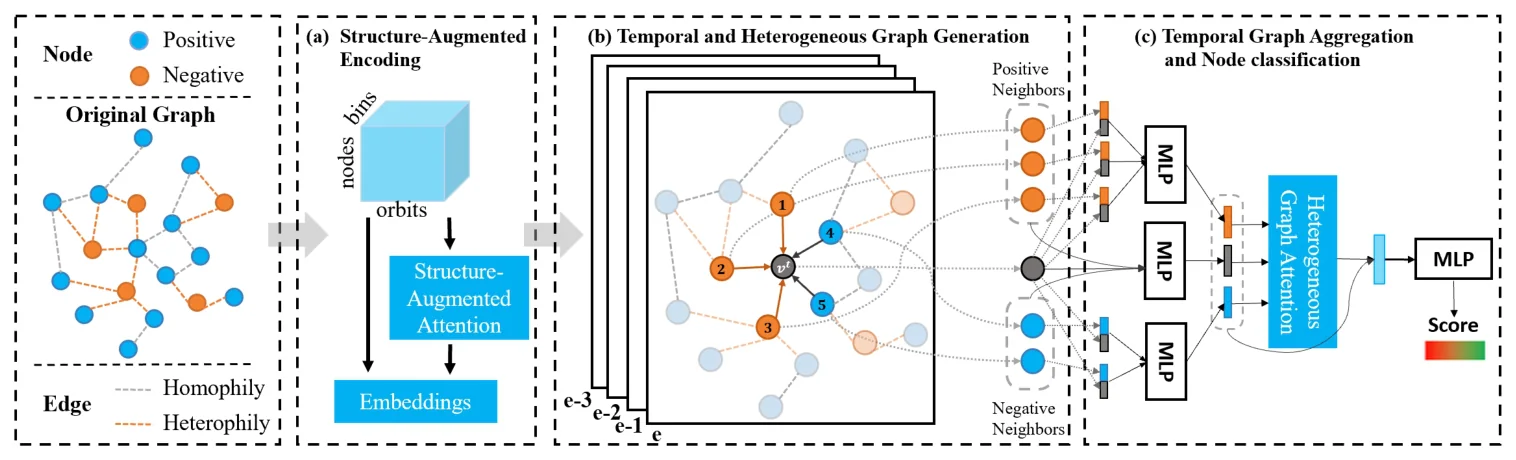
幌骗(spoofing)交易常出现分布漂移,历史数据的有效性随之下降,而模体等交易子结构在不同分布下相对稳定。SAG²M 用枚举算法统计邻居节点间的子图模式频率,将这些模体频率编码进结构增强的生成式框架,再通过时序异构图的生成与聚合收集邻域信息,用于识别合谋幌骗行为。论文在基准数据集上进行了实验,并给出案例分析。
Detecting spoofing in financial trading is a critical data mining task. While traditional machine learning models focus on individual node features, graph-based methodologies have shown superior performance by integrating relational data and structure information. However, spoofing transactions often exhibit distribution shifts, making historical data less effective. Instead, certain consistent trading patterns, such as motif structures, remain robust for analysis across different distributions. Therefore, this paper introduces the Structure-Augmented Generative Graph Model (SAG²M) to detect conspiracy spoofing through substructure frequency-augmented detection. Our approach extracts subgraph pattern frequencies among neighboring nodes using an enumeration algorithm, and encodes these motif frequencies into a structure-augmented generative framework. A temporal and heterogeneous graph generation and aggregation scheme is then applied to collect neighborhood node information, effectively uncovering conspiracy spoofing patterns. Experiments on benchmark datasets demonstrate that SAG²M outperforms existing models in detection accuracy. Case studies further highlight its superior effectiveness in identifying complex fraudulent behaviors.
来源:IJCAI 2026 · 原文摘要