
内容概括
信用卡欺诈检测面临标注稀缺,图神经网络又常忽略特征层面的判别信号。DRESS 用深度强化学习智能体自动捕捉并增强特征层面的风险,与基于图的结构风险融合,再经门控时序注意力网络完成预测;为提高强化学习模块的探索效率,引入特征自注意力层衡量各特征对欺诈检测的贡献,并采用自监督内在奖励辅助优化。实验在真实数据集上进行,并重点考察了仅有 2%–10% 标注样本的低标注场景。
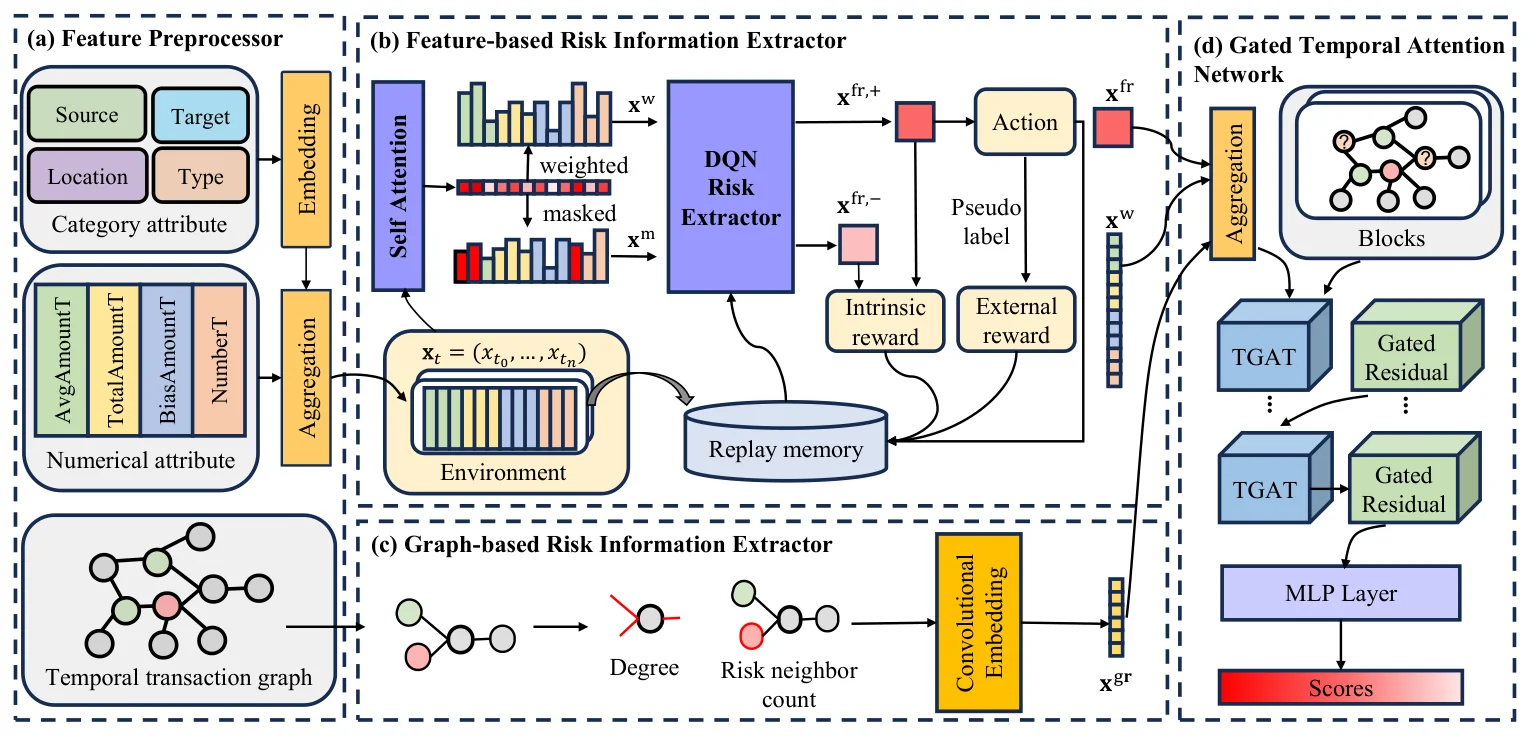
信用卡欺诈检测面临标注稀缺,图神经网络又常忽略特征层面的判别信号。DRESS 用深度强化学习智能体自动捕捉并增强特征层面的风险,与基于图的结构风险融合,再经门控时序注意力网络完成预测;为提高强化学习模块的探索效率,引入特征自注意力层衡量各特征对欺诈检测的贡献,并采用自监督内在奖励辅助优化。实验在真实数据集上进行,并重点考察了仅有 2%–10% 标注样本的低标注场景。
Credit card fraud threatens global payment ecosystems, causing billions in losses and undermining public trust. Efficient fraud detection remains challenging due to surging transaction volumes and evolving tactics. While Graph Neural Networks (GNNs) excel at modeling structural relationships, they struggle in real-world scenarios characterized by label scarcity and often overlook discriminative feature-level signals, leaving rich risk signals underutilized without costly manual engineering. To address this, we propose DRESS, a Deep Reinforcement Learning (DRL) Enhanced Semi-supervised GNN framework. It employs a DRL agent to automatically capture and enhance feature-level risks, fusing them with graph-based structural risks and propagating via a gated temporal attention network for final prediction. To mitigate inefficient exploration of the DRL module, we incorporate a feature self-attention layer to weigh feature contributions to fraud detection and employ self-supervised intrinsic rewards to help optimize the DRL module efficiently. Extensive experiments on real-world datasets demonstrate that DRESS outperforms state-of-the-art methods, especially in low-label scenarios with only 2%–10% labeled samples. By empowering resource-limited institutions to combat fraud and prevent financial loss, DRESS secures the digital trust essential for inclusive growth, contributing to AI for poverty alleviation and economic development.
来源:IJCAI 2026 · 原文摘要