
内容概括
组织化的欺诈者会模仿平台采集的行为数据,使关键特征与正常用户高度一致,论文称之为「自适应伪装」,这削弱了现有图欺诈检测模型的效果。Grad 以有监督图对比学习扩大欺诈与正常节点之间的差异,并用引导式关系扩散生成器从零生成辅助的同配关系,使微弱的欺诈信号在聚合过程中得到增强、更易被捕获。
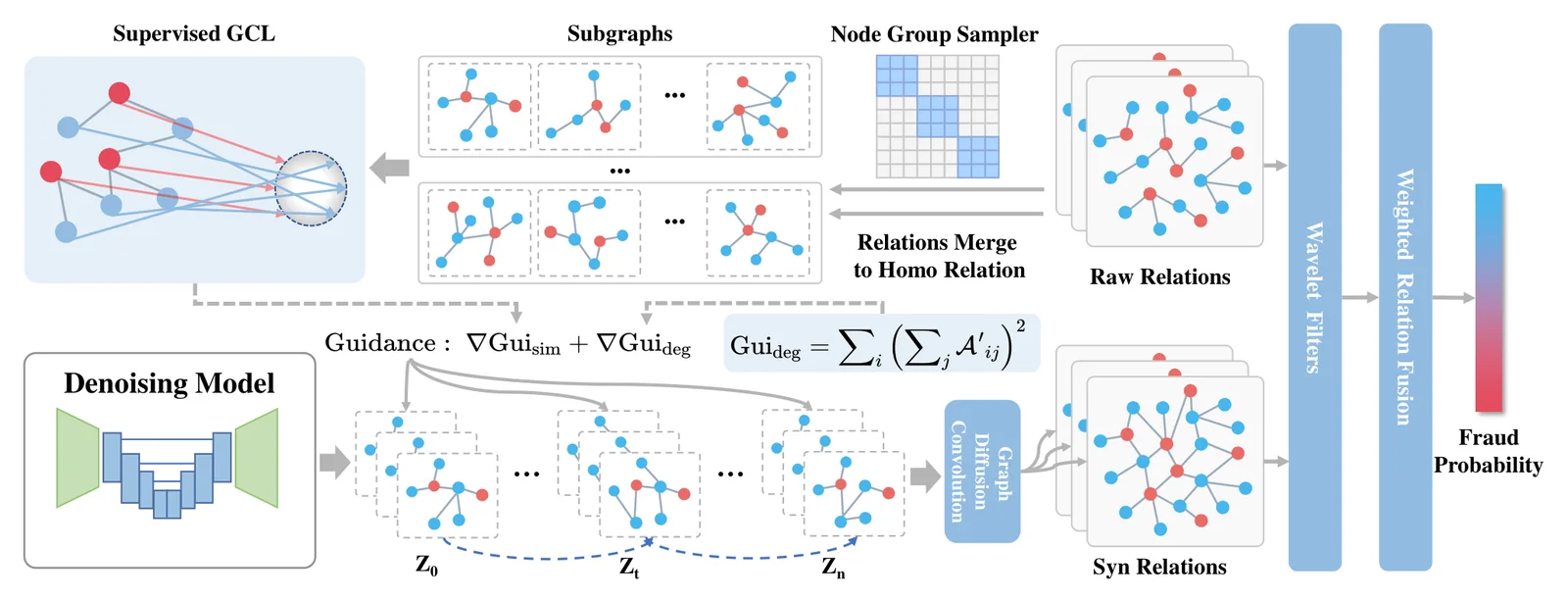
组织化的欺诈者会模仿平台采集的行为数据,使关键特征与正常用户高度一致,论文称之为「自适应伪装」,这削弱了现有图欺诈检测模型的效果。Grad 以有监督图对比学习扩大欺诈与正常节点之间的差异,并用引导式关系扩散生成器从零生成辅助的同配关系,使微弱的欺诈信号在聚合过程中得到增强、更易被捕获。
Nowadays, Graph Fraud Detection (GFD) in financial scenarios has become an urgent research topic to protect online payment security. However, as organized crime groups are becoming more professional in real-world scenarios, fraudsters are employing more sophisticated camouflage strategies. Specifically, fraudsters disguise themselves by mimicking the behavioral data collected by platforms, ensuring that their key characteristics are consistent with those of benign users to a high degree, which we call Adaptive Camouflage. Consequently, this narrows the differences in behavioral traits between them and benign users within the platform's database, thereby making current GFD models lose efficiency. To address this problem, we propose a relation diffusion-based graph augmentation model Grad. In detail, Grad leverages a supervised graph contrastive learning module to enhance the fraud-benign difference and employs a guided relation diffusion generator to generate auxiliary homophilic relations from scratch. Based on these, weak fraudulent signals would be enhanced during the aggregation process, thus being obvious enough to be captured.
来源:WWW 2025 · 原文摘要