
内容概括
现有欺诈检测方法大多依赖充足的历史记录挖掘欺诈模式,难以保护较少参与金融市场、却同样受到欺诈威胁的少数群体,即长尾效应问题。CMR-GNN 先从历史交易中构建多种关系图,设计基于聚类的神经网络模块捕捉交易社区中的多样模式;针对信息不足的尾部节点,引入尾部群组学习模块,用图卷积网络从聚类相似的子图中聚合特征。实验在真实数据集和公开数据集上进行。
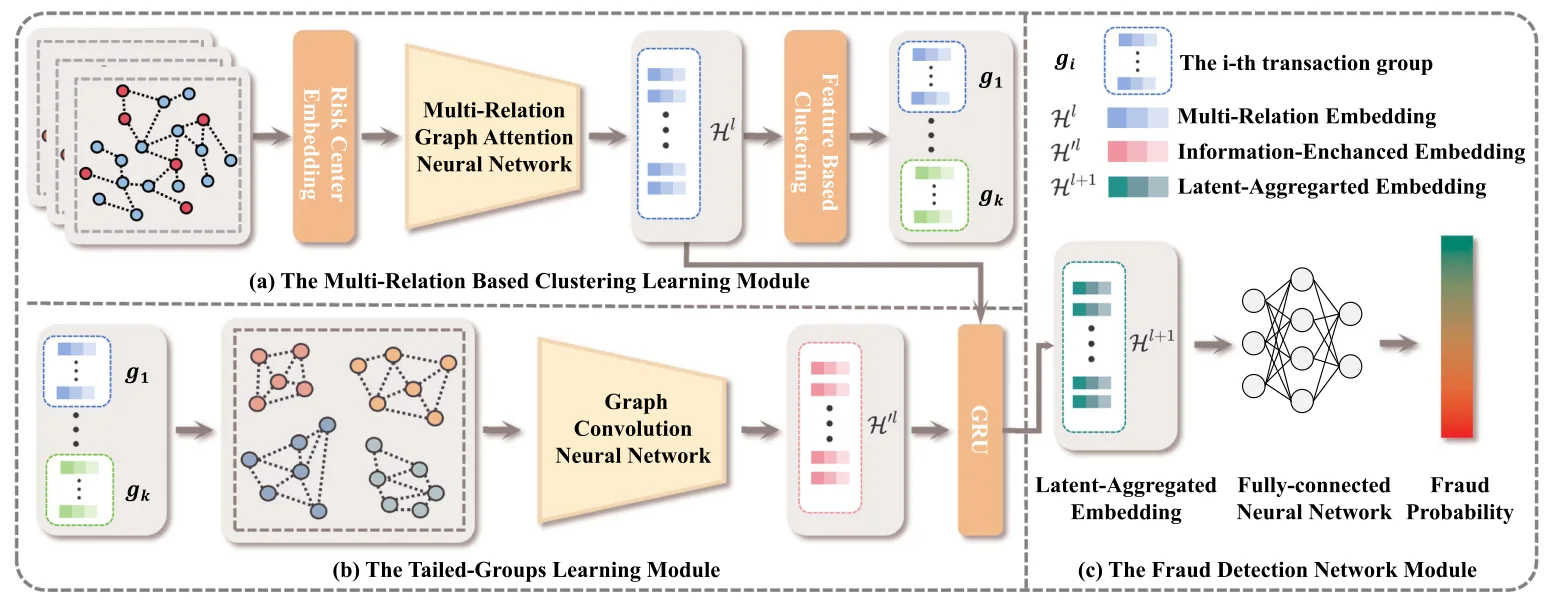
现有欺诈检测方法大多依赖充足的历史记录挖掘欺诈模式,难以保护较少参与金融市场、却同样受到欺诈威胁的少数群体,即长尾效应问题。CMR-GNN 先从历史交易中构建多种关系图,设计基于聚类的神经网络模块捕捉交易社区中的多样模式;针对信息不足的尾部节点,引入尾部群组学习模块,用图卷积网络从聚类相似的子图中聚合特征。实验在真实数据集和公开数据集上进行。
Fraud detection, a classical data mining problem in finance applications, has risen in significance amid the intensifying confrontation between fraudsters and anti-fraud forces. Recently, an increasing number of criminals are constantly expanding the scope of fraud activities to covet the property of innocent victims. However, most existing approaches require abundant historical records to mine fraud patterns from financial transaction behaviors, thereby leading to significant challenges to protect minority groups, who are less involved in the modern financial market but also under the threat of fraudsters nowadays. Therefore, in this paper, we propose a novel community-enhanced multi-relation graph neural network-based model, named CMR-GNN, to address the important defects of existing fraud detection models in the tail effect situation. In particular, we first construct multiple types of relation graphs from historical transactions and then devise a clustering-based neural network module to capture diverse patterns from transaction communities. To mitigate information lacking tailed nodes, we proposed tailed-groups learning modules to aggregate features from similarly clustered subgraphs by graph convolution networks. Extensive experiments on both the real-world and public datasets demonstrate that our method not only surpasses the state-of-the-art baselines but also could effectively harness information within transaction communities while mitigating the impact of tail effects.
来源:TKDE 2025 · 原文摘要