
内容概括
真实时间序列在不同尺度上呈现不同模式,未来变化受多个相互交织的尺度共同影响。Transformer 类方法擅长捕捉长程依赖,但计算复杂度高、容易过拟合;MLP 类方法计算高效,却难以刻画尺度复杂的时间模式。基于对时间序列多尺度纠缠效应的观察,AMD 以多尺度可分解混合模块将序列分解为不同尺度的时间模式并加以聚合,配合双重依赖交互模块与自适应多预测器合成模块,同时建模时间依赖与通道依赖,并利用自相关性优化多尺度信息的融合。
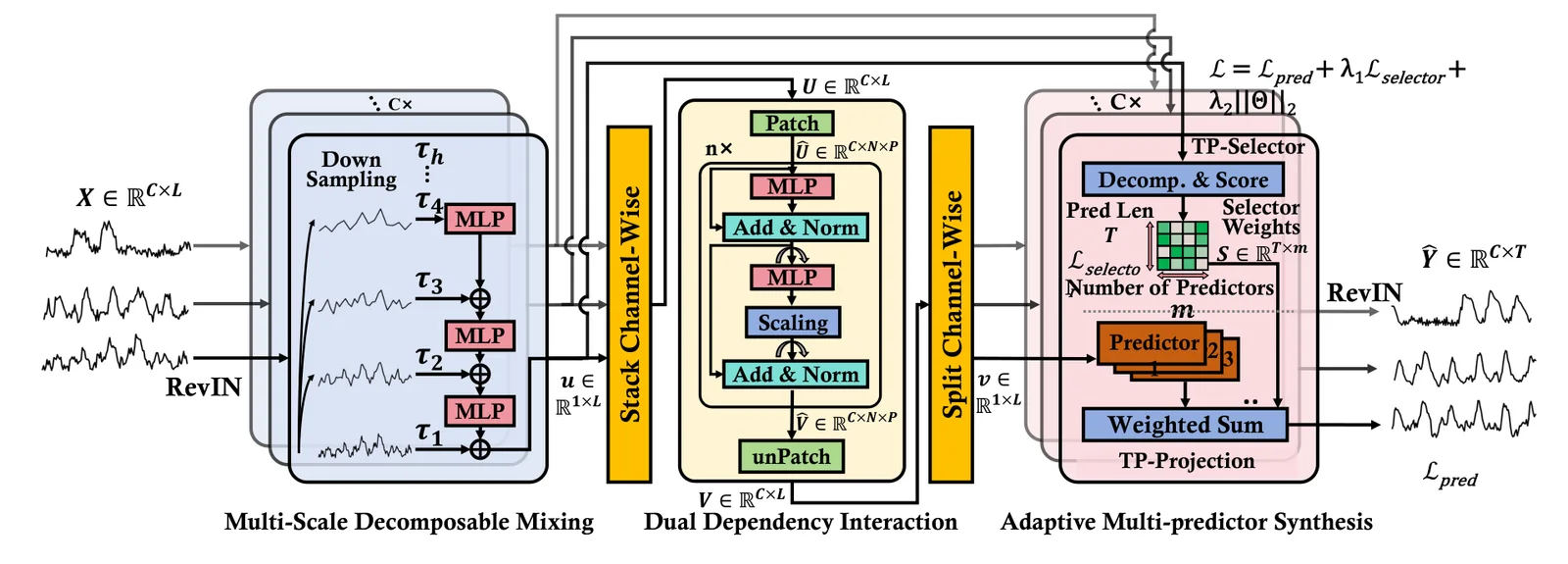
真实时间序列在不同尺度上呈现不同模式,未来变化受多个相互交织的尺度共同影响。Transformer 类方法擅长捕捉长程依赖,但计算复杂度高、容易过拟合;MLP 类方法计算高效,却难以刻画尺度复杂的时间模式。基于对时间序列多尺度纠缠效应的观察,AMD 以多尺度可分解混合模块将序列分解为不同尺度的时间模式并加以聚合,配合双重依赖交互模块与自适应多预测器合成模块,同时建模时间依赖与通道依赖,并利用自相关性优化多尺度信息的融合。
Transformer-based and MLP-based methods have emerged as leading approaches in time series forecasting (TSF). However, real-world time series often show different patterns at different scales, and future changes are shaped by the interplay of these overlapping scales, requiring high-capacity models. While Transformer-based methods excel in capturing long-range dependencies, they suffer from high computational complexities and tend to overfit. Conversely, MLP-based methods offer computational efficiency and adeptness in modeling temporal dynamics, but they struggle with capturing temporal patterns with complex scales effectively. Based on the observation of multi-scale entanglement effect in time series, we propose a novel MLP-based Adaptive Multi-Scale Decomposition (AMD) framework for TSF. Our framework decomposes time series into distinct temporal patterns at multiple scales, leveraging the Multi-Scale Decomposable Mixing (MDM) block to dissect and aggregate these patterns. Complemented by the Dual Dependency Interaction (DDI) block and the Adaptive Multi-predictor Synthesis (AMS) block, our approach effectively models both temporal and channel dependencies and utilizes autocorrelation to refine multi-scale data integration. Comprehensive experiments demonstrate our AMD framework not only overcomes the limitations of existing methods but also consistently achieves state-of-the-art performance across various datasets.
来源:AAAI 2025 · 原文摘要