
内容概括
基于图神经网络的欺诈检测模型存在鲁棒性缺陷,欺诈者可通过数据投毒等攻击误导模型;现有攻防模型多在理想设定下研究,截断或过滤时还会损失信息。论文先设计同时篡改图特征与结构的攻击算法,模拟真实复杂欺诈场景中的攻击行为;再对图做奇异值分解,在图神经网络中以专门设计的联合损失学习分解后的矩阵,使模型在低秩子空间中学习图模式、尽量保留细节信息,并让图结构符合类别同配与稀疏等特性。实验基于真实欺诈数据集。
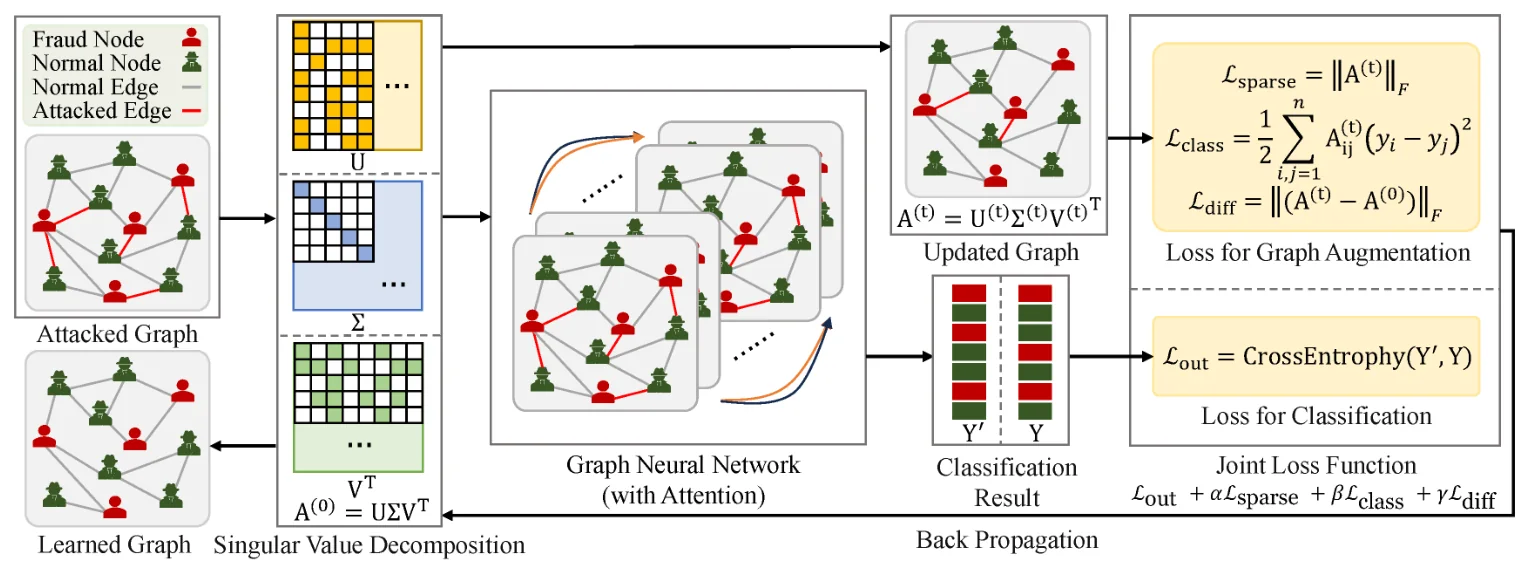
基于图神经网络的欺诈检测模型存在鲁棒性缺陷,欺诈者可通过数据投毒等攻击误导模型;现有攻防模型多在理想设定下研究,截断或过滤时还会损失信息。论文先设计同时篡改图特征与结构的攻击算法,模拟真实复杂欺诈场景中的攻击行为;再对图做奇异值分解,在图神经网络中以专门设计的联合损失学习分解后的矩阵,使模型在低秩子空间中学习图模式、尽量保留细节信息,并让图结构符合类别同配与稀疏等特性。实验基于真实欺诈数据集。
Financial fraud is one of the most significant social issues and has caused tremendous property losses. Graph neural networks (GNNs) have been applied to anti-fraud practices and achieved decent results. However, recent researches have discovered flaws in the robustness of fraud-detection models based on GNNs, enabling fraudsters to mislead them through attacks like data poisoning. In addition, most existing attack-defense models tend to study on ideal settings and lose information during truncation or filtering, which lowers their performances in complicated financial fraud cases. Therefore, in this paper, we propose a novel robust anti-fraud GNN model. In particular, we first design an attack algorithm tampering with both features and structures of graph data to simulate fraudsters’ attacking behaviors in real-life complex fraud scenarios. Then we apply singular value decomposition to the graph and learn the decomposed matrices in a GNN model with specifically designed joint losses. This enables our model to learn the graph patterns in low-rank subspaces without losing too much detailed information and fit the graph structure to characteristics including class-homophily and sparsity to guarantee robustness. The proposed approach is experimented on real-world fraud datasets, which demonstrates its advantages in fraud detection and robustness compared with the state-of-the-art baselines.
来源:IJCAI 2024 · 原文摘要