
内容概括
欺诈者常借助多个正常用户进行间接交易以掩盖关联,而图神经网络在深层聚合中的过平滑使模型难以学习这类多跳伪装交易的特征。HOGRL 先构建高阶交易图,直接学习各阶的纯净表示,以识别欺诈者的多跳间接交易;再引入混合专家注意力机制,自动确定不同阶表示的重要性并联合优化检测性能。论文在开源数据集与真实数据集上进行了验证。
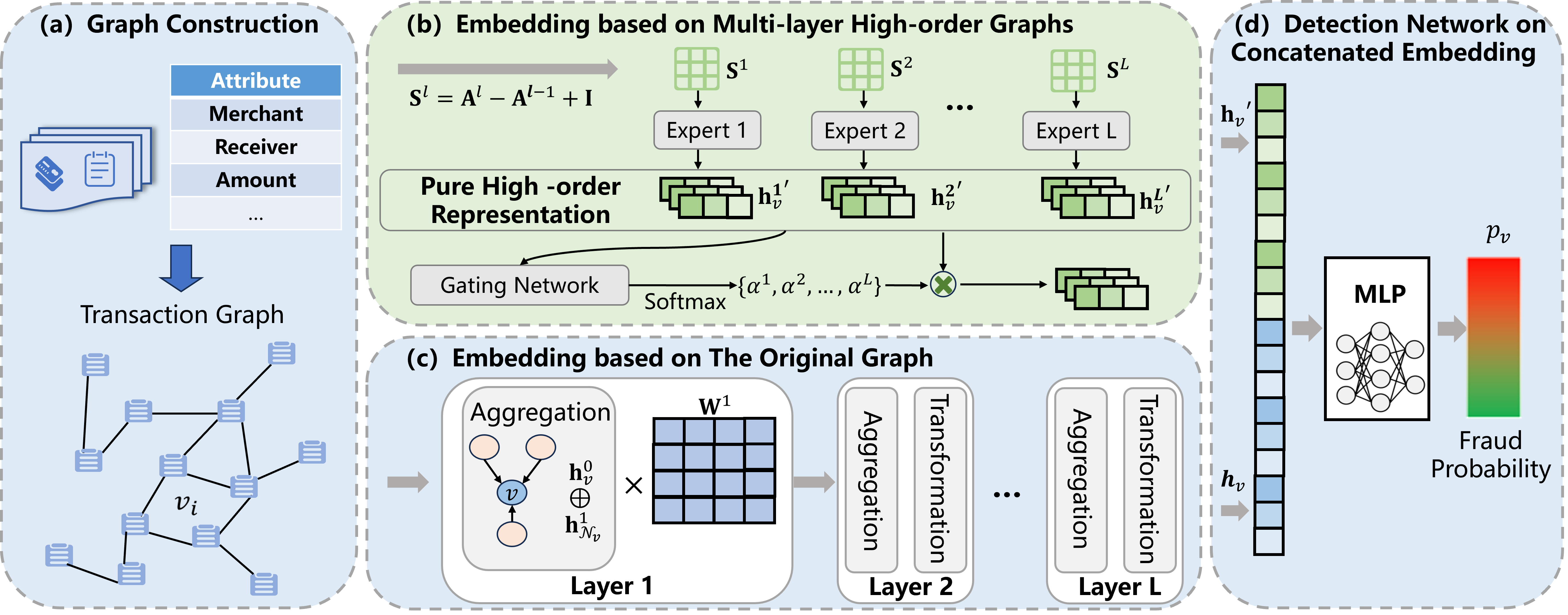
欺诈者常借助多个正常用户进行间接交易以掩盖关联,而图神经网络在深层聚合中的过平滑使模型难以学习这类多跳伪装交易的特征。HOGRL 先构建高阶交易图,直接学习各阶的纯净表示,以识别欺诈者的多跳间接交易;再引入混合专家注意力机制,自动确定不同阶表示的重要性并联合优化检测性能。论文在开源数据集与真实数据集上进行了验证。
Credit card fraud imposes significant costs on both cardholders and issuing banks. Fraudsters often disguise their crimes, such as using legitimate transactions through several benign users to bypass anti-fraud detection. Existing graph neural network (GNN) models struggle with learning features of camouflaged, indirect multi-hop transactions due to their inherent over-smoothing issues in deep multi-layer aggregation, presenting a major challenge in detecting disguised relationships. Therefore, in this paper, we propose a novel High-order Graph Representation Learning model (HOGRL) to avoid incorporating excessive noise during the multi-layer aggregation process. In particular, HOGRL learns different orders of pure representations directly from high-order transaction graphs. We realize this goal by effectively constructing high-order transaction graphs first and then learning the pure representations of each order so that the model could identify fraudsters' multi-hop indirect transactions via multi-layer pure feature learning. In addition, we introduce a mixture-of-expert attention mechanism to automatically determine the importance of different orders for jointly optimizing fraud detection performance. We conduct extensive experiments in both the open source and real-world datasets, the result demonstrates the significant improvements of our proposed HOGRL compared with state-of-the-art fraud detection baselines.
来源:IJCAI 2024 · 原文摘要