
内容概括
幌骗交易的模式跨越多个交互层次,既涉及单笔交易的局部结构,也涉及幌骗团伙和全局模式;只依赖局部上下文难以捕捉多粒度风险信号,现有方法也未区分不同粒度特征的差异与相对重要性。论文提出多粒度增强图学习方法 MGGNN,通过多跳差分聚合与社区增强策略,从局部、团伙到全局区分地捕捉欺诈信号,并自适应区分各粒度的贡献;为避免多粒度信息过度融合,联合对比损失与交叉熵损失进行优化。实验基于真实数据集。
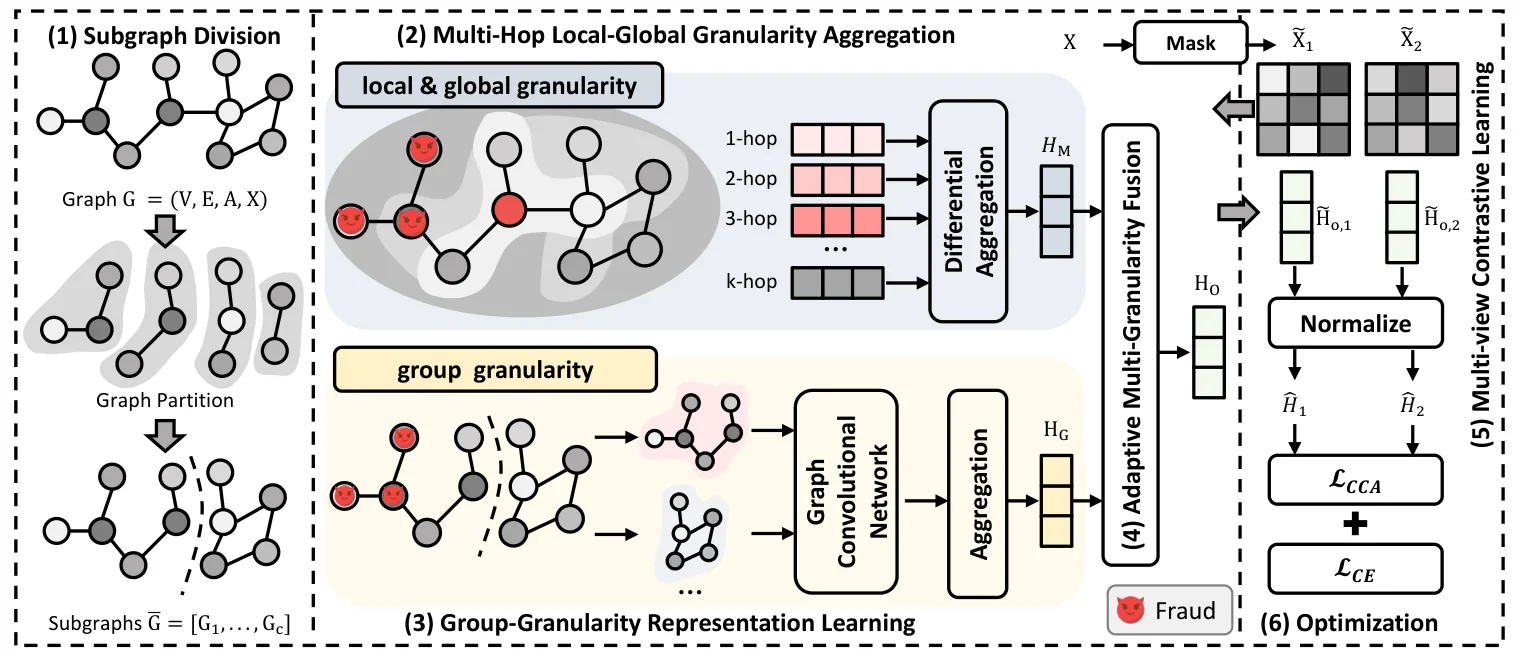
幌骗交易的模式跨越多个交互层次,既涉及单笔交易的局部结构,也涉及幌骗团伙和全局模式;只依赖局部上下文难以捕捉多粒度风险信号,现有方法也未区分不同粒度特征的差异与相对重要性。论文提出多粒度增强图学习方法 MGGNN,通过多跳差分聚合与社区增强策略,从局部、团伙到全局区分地捕捉欺诈信号,并自适应区分各粒度的贡献;为避免多粒度信息过度融合,联合对比损失与交叉熵损失进行优化。实验基于真实数据集。
Spoofing is a deceptive trading strategy where fraudsters place a large number of fake orders to manipulate market prices, severely distorting market fairness and threatening market stability. With the advancement of fraudulent tactics, spoofing patterns span across various levels of interaction, involving not only the local structure of individual spoofing transactions but also spoofing groups and global patterns. Relying solely on local context makes it challenging to capture multi-granularity risk signals, especially for organized and covert spoofing. Additionally, existing methods fail to consider the differences and relative importance between features of varying granularity, leading to feature distortion and noise. Therefore, we propose a multi-granularity augmented graph learning method that differentially captures fraud signals at local, group, and global levels. It utilizes multi-hop differential aggregation and community-augmented strategy to capture information from local to global perspectives, adaptively distinguishing the contributions of different granularity. To avoid excessive fusion of multi-granularity information, we combine contrastive loss and cross-entropy loss for joint optimization, preserving key features while enhancing the method’s robustness and accuracy. Extensive experiments on real-world datasets demonstrate the effectiveness of our proposed approach in spoofing detection, providing a robust solution for regulatory agencies. Our work will help financial institutions enhance their regulatory capabilities, protect investors’ interests, and promote the healthy development of financial markets.
来源:WWW 2025 · 原文摘要