
内容概括
有组织的医疗保险欺诈每年造成数十亿美元损失,而现有工作多检测单个欺诈实体或理赔,忽略了隐藏的合谋模式。RDPGL 先用异构图注意力网络从受益人—服务提供方图中编码局部上下文,再设计社区感知的风险扩散模型,基于理赔—理赔关系图推断有组织欺诈行为的全局上下文;局部与全局表示并行拼接,端到端联合训练。实验基于真实医疗保险数据集。
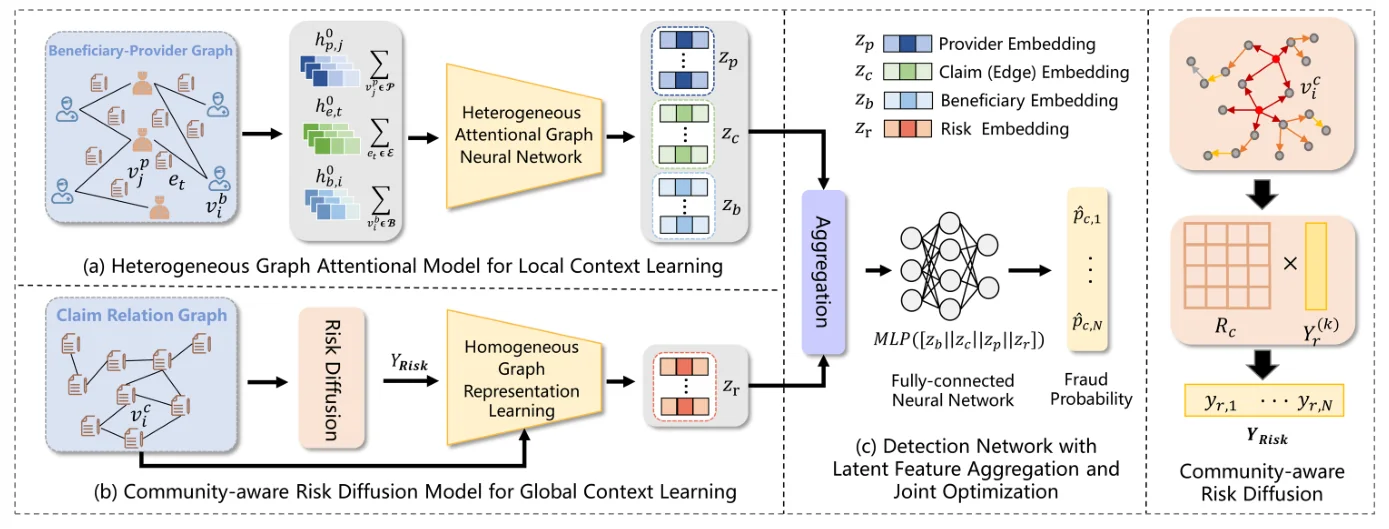
有组织的医疗保险欺诈每年造成数十亿美元损失,而现有工作多检测单个欺诈实体或理赔,忽略了隐藏的合谋模式。RDPGL 先用异构图注意力网络从受益人—服务提供方图中编码局部上下文,再设计社区感知的风险扩散模型,基于理赔—理赔关系图推断有组织欺诈行为的全局上下文;局部与全局表示并行拼接,端到端联合训练。实验基于真实医疗保险数据集。
Medical insurance plays a vital role in modern society, yet organized healthcare fraud causes billions of dollars in annual losses, severely harming the sustainability of the social welfare system. Existing works mostly focus on detecting individual fraud entities or claims, ignoring hidden conspiracy patterns. Hence, they face severe challenges in tackling organized fraud. In this paper, we proposed RDPGL, a novel Risk Diffusion-based Parallel Graph Learning approach, to fighting against medical insurance criminal gangs. In particular, we first leverage a heterogeneous graph attention network to encode the local context from the beneficiary-provider graph. Then, we devise a community-aware risk diffusion model to infer the global context of organized fraud behaviors with the claim-claim relation graph. The local and global representations are parallel concatenated together and trained simultaneously in an end-to-end manner. Our approach is extensively evaluated on a real-world medical insurance dataset. The experimental results demonstrate the superiority of our proposed approach, which could detect more organized fraud claims with relatively high precision compared with state-of-the-art baselines.
来源:IJCAI 2023 · 原文摘要