
内容概括
真实交易中只有很小比例带有标注,难以充分利用未标注数据中的特征。GTAN 以交易为节点、交易间交互为边构建时序交易图,通过门控时序注意力网络在节点间传递信息、学习交易表示,并借助交易间的风险传播刻画欺诈模式,是一种半监督图神经网络方法。论文在一个真实交易数据集与两个公开欺诈检测数据集上验证,半监督实验考察了仅有少量标注数据时的检测效果。
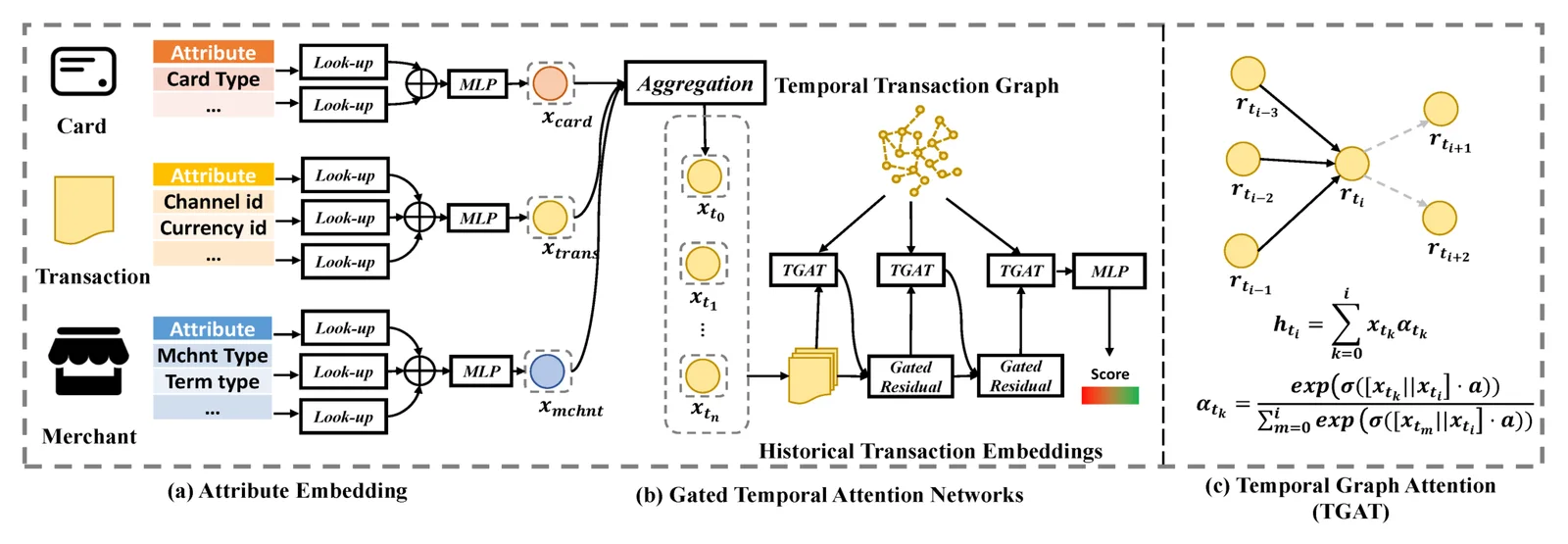
真实交易中只有很小比例带有标注,难以充分利用未标注数据中的特征。GTAN 以交易为节点、交易间交互为边构建时序交易图,通过门控时序注意力网络在节点间传递信息、学习交易表示,并借助交易间的风险传播刻画欺诈模式,是一种半监督图神经网络方法。论文在一个真实交易数据集与两个公开欺诈检测数据集上验证,半监督实验考察了仅有少量标注数据时的检测效果。
Credit card fraud incurs a considerable cost for both cardholders and issuing banks. Contemporary methods apply machine learning-based classifiers to detect fraudulent behavior from labeled transaction records. But labeled data are usually a small proportion of billions of real transactions due to expensive labeling costs, which implies that they do not well exploit many natural features from unlabeled data. Therefore, we propose a semi-supervised graph neural network for fraud detection. Specifically, we leverage transaction records to construct a temporal transaction graph, which is composed of temporal transactions (nodes) and interactions (edges) among them. Then we pass messages among the nodes through a Gated Temporal Attention Network (GTAN) to learn the transaction representation. We further model the fraud patterns through risk propagation among transactions. The extensive experiments are conducted on a real-world transaction dataset and two publicly available fraud detection datasets. The result shows that our proposed method, namely GTAN, outperforms other state-of-the-art baselines on three fraud detection datasets. Semi-supervised experiments demonstrate the excellent fraud detection performance of our model with only a tiny proportion of labeled data.
来源:AAAI 2023 · 原文摘要