
内容概括
现有基于图神经网络的股票预测方法有三方面不足:难以显式刻画金融时间序列内生的随机性;忽视股票之间在时间轴上存在系统性延迟的超前—滞后关系;依赖离散时间更新,难以表示市场的连续时间演化。DGNSDE 采用“轨迹重建—斜率预测”两阶段策略,将连续时间神经随机微分方程与延迟感知的图构建相结合。实验覆盖沪深 300、中证 500、纳斯达克 100 与标普 500 等真实股票数据集,模型还在实际交易系统中进行了部署。
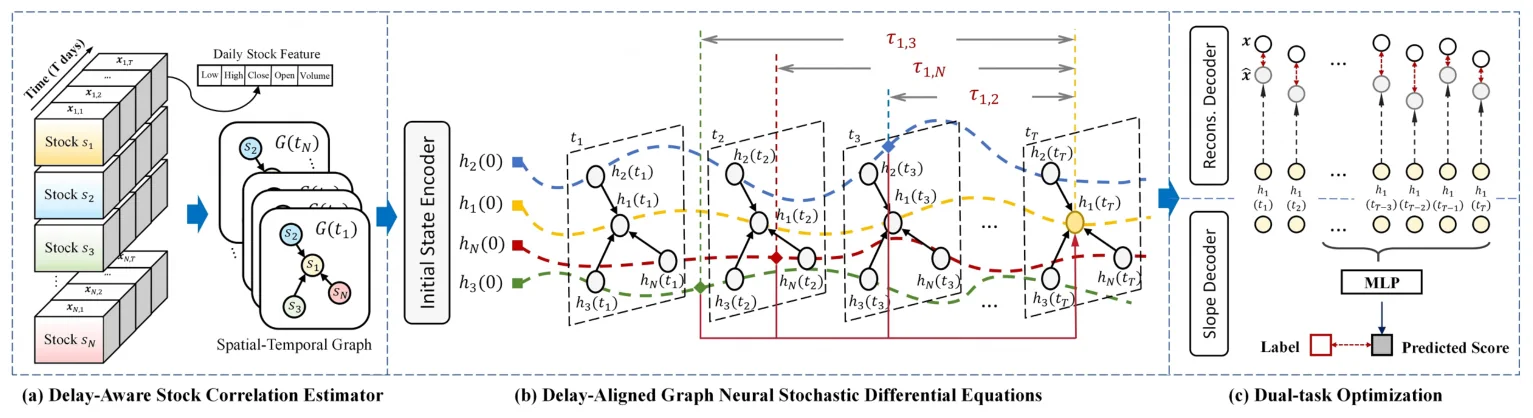
现有基于图神经网络的股票预测方法有三方面不足:难以显式刻画金融时间序列内生的随机性;忽视股票之间在时间轴上存在系统性延迟的超前—滞后关系;依赖离散时间更新,难以表示市场的连续时间演化。DGNSDE 采用“轨迹重建—斜率预测”两阶段策略,将连续时间神经随机微分方程与延迟感知的图构建相结合。实验覆盖沪深 300、中证 500、纳斯达克 100 与标普 500 等真实股票数据集,模型还在实际交易系统中进行了部署。
Financial time series forecasting remains a notoriously difficult task due to the natures of nonlinear dynamics, low signal-to-noise ratios, and evolving inter-stock dependencies. Traditional models often treat stocks as independent sequences, ignoring both temporal patterns and relational market structures. While recent GNN-based methods attempt to simplify higher-order relationships between stocks in the form of pairs, they still face three crucial limitations: 1) the inability to explicitly model the endogenous stochasticity inherent in financial time series, 2) the neglect of inter-stock dependencies that are not aligned on the time axis but exhibit systematic delays, i.e., lead–lag effects between stocks, and 3) a reliance on discrete-time updates, which restricts their capacity to represent the continuous-time evolution of financial markets. To overcome these challenges, we propose a novel Delay-Aware Graph Neural Stochastic Differential Equations (DGNSDE)-based framework that adopts a two-stage strategy consisting of trajectory reconstruction followed by slope prediction, while tightly integrating continuous-time neural stochastic differential equations with delay-aware graph construction. Extensive experiments conducted on multiple real-world stock market datasets, including CSI300, CSI500, NASDAQ100, and S&P500, consistently demonstrate that DGNSDE outperforms state-of-the-art baselines across both ranking-based and investment-oriented evaluation metrics, highlighting its strong generalization ability. Furthermore, deployment in a real operational trading system shows that DGNSDE significantly improves robustness under market regime shifts and delivers superior risk-adjusted returns, thereby underscoring its practical effectiveness and scalability for large-scale quantitative investment.
来源:WWW 2026 · 原文摘要