
内容概括
现有基于图的股票预测方法难以有效学习分钟、日、周等不同频率下的多粒度时序关系。论文提出多粒度图增强学习框架:用周、日、分钟三级粒度的金融时间序列构建时序收益关系图,同时刻画股票间的中期趋势与短期波动;再设计注意力图增强模块,结合基本面数据增强节点关系,并在预测层联合优化。实验覆盖中国与美国股票市场的多个数据集,以 ARR、ASR、CR、IR 四项指标评估,模型已在商业交易平台上应用测试。
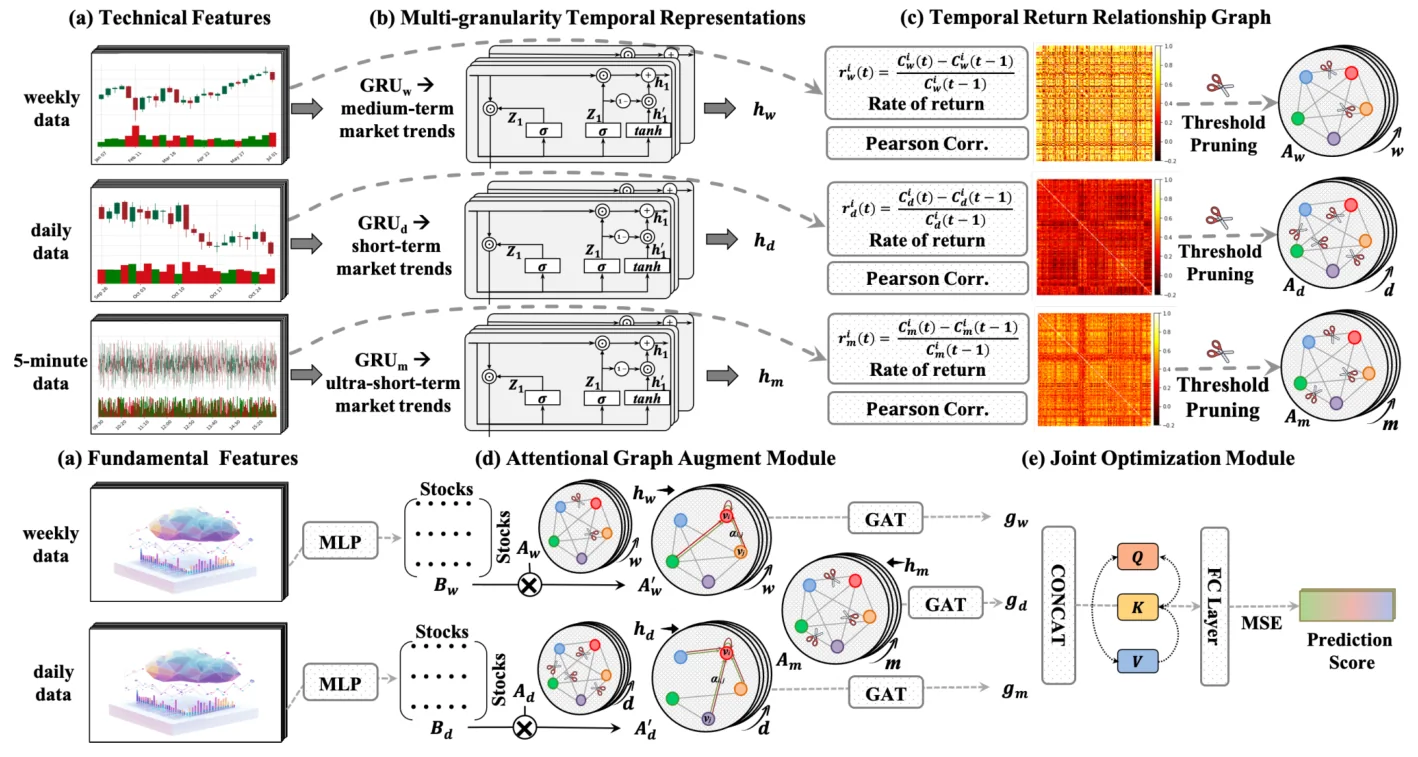
现有基于图的股票预测方法难以有效学习分钟、日、周等不同频率下的多粒度时序关系。论文提出多粒度图增强学习框架:用周、日、分钟三级粒度的金融时间序列构建时序收益关系图,同时刻画股票间的中期趋势与短期波动;再设计注意力图增强模块,结合基本面数据增强节点关系,并在预测层联合优化。实验覆盖中国与美国股票市场的多个数据集,以 ARR、ASR、CR、IR 四项指标评估,模型已在商业交易平台上应用测试。
Financial time series prediction is an important and challenging data mining task for quantitative investment. The inherent non-linearity, high noise, and susceptibility to various factors, such as macroeconomic conditions and market sentiment in the stock market, increase the difficulty of prediction. Existing financial industries mainly employ time series models or fundamental analysis methods for prediction. However, these methods fail to effectively capture the complex interrelationships between equity. In recent years, graph neural networks (GNNs), due to their powerful relational modeling capabilities, have been applied to stock prediction. However, with the advances of recent digital power, such as widely-used high-frequency trading techniques, existing graph-based methods still have shortcomings in effectively learning multi-granularity temporal relations as they cannot effectively learn the patterns in different frequencies, e.g., minute-level, daily, weekly, etc. Therefore, in this paper, we propose a multi-granularity graph augmented learning framework for interrelated financial time series forecasting. We first construct a temporal return relationship graph with multi-granularity financial time series, including weekly, daily, and minute-level, to comprehensively capture the dynamic relations of equities, including both medium-term trends and short-term fluctuations. Then, to further augment the node relations, we devise an attentional graph augment module to improve the graph learning with fundamental data, which are jointly optimized in the prediction layer. We conduct extensive empirical studies on multiple datasets from both the Chinese and U.S. stock markets. The results demonstrate that our proposed model consistently outperforms existing baseline methods across four key financial metrics, including ARR, ASR, CR, and IR, thereby validating its effectiveness and superiority. The model has been applied and empirically tested in commercial-grade trading platforms, further demonstrating its efficiency and robustness in real-world trading environments.
来源:TKDE 2025 · 原文摘要