
内容概括
PSAGNN 同时防御针对银行间信用评级的特征投毒与结构投毒(非目标)攻击:采用结合有偏扰动的分阶段优化策略,利用银行间网络的偏好连接与无标度特性,自适应地为投毒训练数据排定优先级并模拟干净图,再在目标函数中施加加权惩罚以区分攻击者。论文在新采集的银行间季度数据集上进行了实验与案例分析。
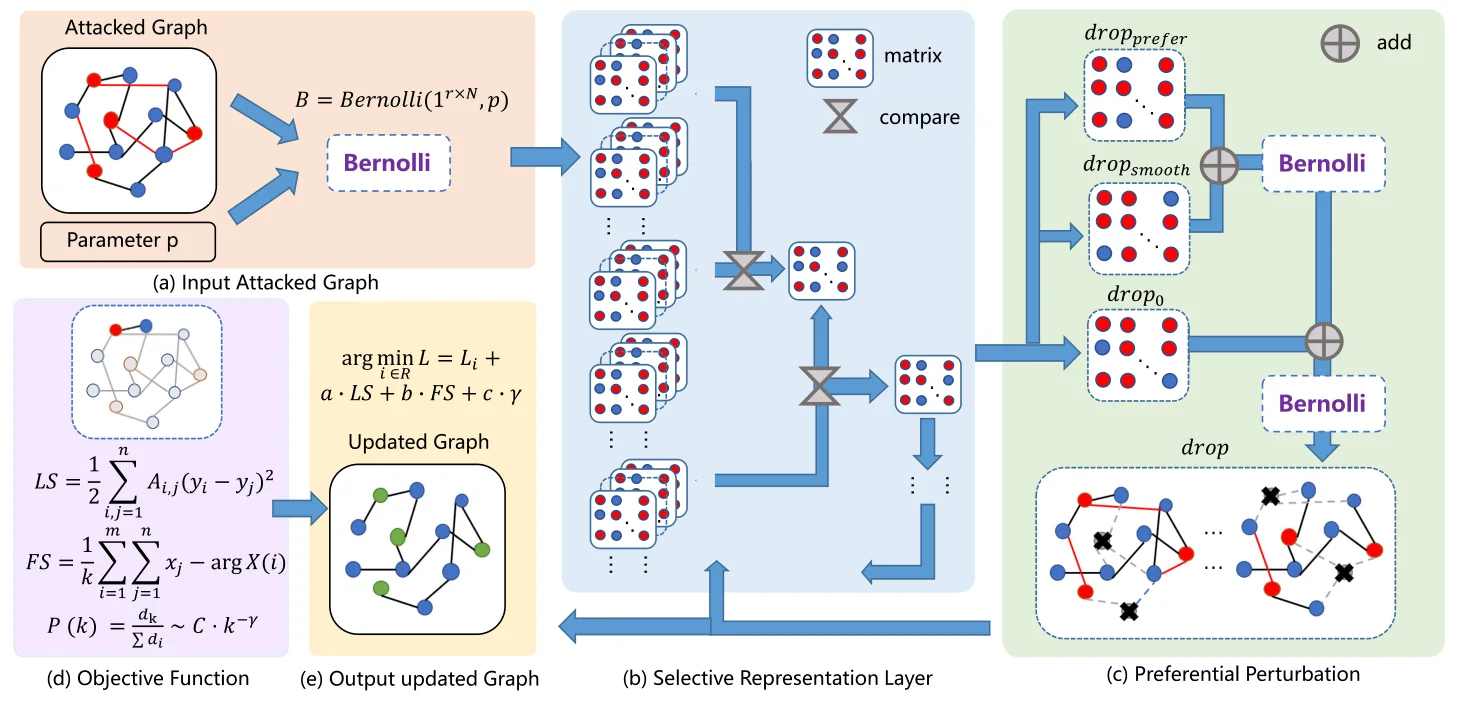
PSAGNN 同时防御针对银行间信用评级的特征投毒与结构投毒(非目标)攻击:采用结合有偏扰动的分阶段优化策略,利用银行间网络的偏好连接与无标度特性,自适应地为投毒训练数据排定优先级并模拟干净图,再在目标函数中施加加权惩罚以区分攻击者。论文在新采集的银行间季度数据集上进行了实验与案例分析。
Accurately assessing and forecasting bank credit ratings at an early stage is vitally important for a healthy financial environment and sustainable economic development. However, the evaluation process faces challenges due to individual attacks on the rating model. Some participants may provide manipulated information in an attempt to undermine the rating model and secure higher scores, further complicating the evaluation process. Therefore, we propose a novel approach called the preferential selective-aware graph neural network (PSAGNN) model to simultaneously defend against feature and structural nontarget poisoning attacks on Interbank credit ratings. In particular, the model establishes a phased optimization approach combined with biased perturbation and explores the Interbank preferences and scale-free nature of networks, to adaptively prioritize the poisoning training data and simulate a clean graph. Finally, we apply a weighted penalty on the opposition function to optimize the model so that the model can distinguish between attackers. Extensive experiments on our newly collected Interbank quarter dataset and case studies demonstrate the superior performance of our proposed approach in preventing credit rating attacks compared to state-of-the-art baselines.
来源:TNNLS 2024 · 原文摘要