
内容概括
越来越多的洗钱活动由有组织的犯罪团伙实施,而现有方法大多把每个账户的行为视为独立的个体行为,未考虑团伙层面的合谋交互。论文提出团伙感知的深度图学习方法:设计以社区为中心的编码器表示用户交易图中的节点与属性,推导相邻的团伙行为;再通过局部增强方案,将交易特征相近的节点聚合为团伙用于下游检测。实验使用全球大型银行卡联盟之一的真实数据,覆盖离线与在线两种模式。
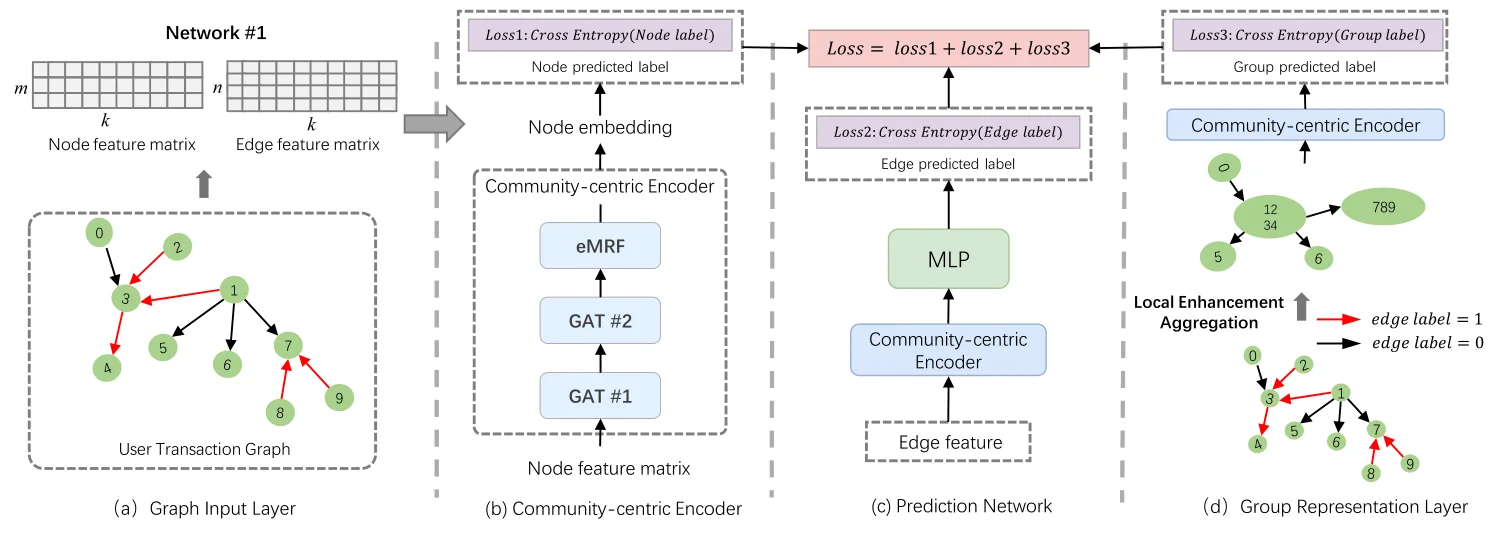
越来越多的洗钱活动由有组织的犯罪团伙实施,而现有方法大多把每个账户的行为视为独立的个体行为,未考虑团伙层面的合谋交互。论文提出团伙感知的深度图学习方法:设计以社区为中心的编码器表示用户交易图中的节点与属性,推导相邻的团伙行为;再通过局部增强方案,将交易特征相近的节点聚合为团伙用于下游检测。实验使用全球大型银行卡联盟之一的真实数据,覆盖离线与在线两种模式。
Anti-money laundering (AML) is a classical data mining problem in finance applications. As well known, money laundering (ML) is critical to the effective operation of transnational and organized crime, which affects a country's economy, government, and social wellbeings. Financial services organizations facilitate the movement of money and have been enlisted by governments to assist with the detection and prevention of money laundering, which is a key tool in the fight to reduce crime and create sustainable economic development. In the application of AML, user identity and financial behavior data are widely used to detect laundering transactions. In recent years, an increasing number of money laundering activities have been conducted by organized criminal gangs while most existing works still treat the actions of each account as independent identity behavior without considering the group-level conspired interactions. Therefore, in this paper, we propose a group-aware deep graph learning-based approach for organized money-laundering detection. In particular, we design a community-centric encoder to represent the nodes and attributes in user transaction graphs and derive the adjacent gang behaviors. Then, we devise a scheme of local enhancement to accommodate nodes with similar transaction features, which are aggregated into gangs for downstream detection. Extensive experiments on the real-world dataset from one of the largest bank card alliances worldwide show that our proposed method outperforms state-of-the-art methods in both offline and online modes, showing the effectiveness of money laundering detection with group-aware deep graph learning.
来源:TKDE 2023 · 原文摘要